

Most guides to Kurdish rugs from Iran return to two familiar names, Senneh and Bijar. Early twentieth-century rug books, however, also used a third name that has largely disappeared from the market: Savojbolagh, written in English as Sauj Bulagh, Souj Bulak or Suj-Bulak. It belonged to a town south of Lake Urmia that is now called Mahabad, and to the heavy, darkly coloured Kurdish rugs that reached Western dealers from its surroundings.
The name is worth recovering because it describes something real: a regional group of village and tribal weaving in the Mokrian area of north-western Iran. It is also worth handling carefully. Savojbolagh was a market label before it was a scholarly category, and the writers who used it did not always agree on what it meant. Understanding both sides of that story makes these rugs easier to appreciate, and easier to describe honestly.

A town, a region and a name
Savojbolagh is usually explained as a Turkic name meaning "cold spring". For centuries it was the main town of Mokrian, the Kurdish region that stretches south of Lake Urmia toward Bukan, Sardasht and Oshnavieh. The Mokri rulers made it their centre for roughly four hundred years, until the middle of the nineteenth century. The town took the name Mahabad in the twentieth century, but the older name survives in coinage, travel writing, photographs and rug books.

For carpet history, geography matters because Mokrian sat between larger and better documented weaving areas. Tabriz and the Heriz villages lie to the north-east. Senneh, now Sanandaj, and the Bijar district lie to the south-east. Across the mountains to the west and south-west were the Kurdish weaving communities that Western markets grouped under the city name Mosul. Rugs moved along these routes, and so did designs, dyes and weavers.
The people who wove in the region were not a single tribe. William Eagleton, an American diplomat whose 1988 book was the first broad study of Kurdish rugs from Iran, Iraq and Turkey, listed several Mokrian groups associated with weaving, including the Gork, Mamash, Mangur, Piran, Mokri and Dehbokri. The Dehbokri name appears most often in attributions in Western collections. Most of the weaving was done by women alongside other household and farm work, so a rug could take a long time to finish. That may also help explain why so many surviving pieces are small, practical rugs rather than large commissioned carpets.
What early rug books said
The best way to see how the category was formed is to read the books that formed it. Two American guides from the years before the First World War describe Savojbolagh rugs in detail, and their descriptions are both useful and revealing.
Walter A. Hawley, writing in 1913, placed "Suj-Bulak" among the rugs of the Tabriz district rather than with Mosul. He described the town as an old Kurdish capital about fifty miles south of Lake Urmia, and its rugs as strongly Kurdish in their sturdy texture, excellent wool, rich dark colours and finishing. In old pieces, he wrote, deep red and deep blue dominate. One usually forms the ground of the central field, often shading gradually from one end to the other, while the other carries the pattern. That gradual shading is what rug collectors call abrash, a natural variation in dyed wool that is explained in our guide to abrash.
Hawley also noticed a Persian influence in the drawing. He describes flowering plants such as rose bushes arranged in upright rows, detached flowers along the edges of the field, and wide borders of vines. His technical notes are specific: symmetrical (Turkish or Ghiordes) knots, wool warp and weft, two weft passes between each row of knots, medium-length wool pile, and three or four border stripes. He added a detail any careful buyer can still check. On the back of a typical piece, the rows of knots look uneven or serrated rather than perfectly aligned.
George Griffin Lewis, whose guide first appeared in 1911, agreed on the symmetrical knot, the soft and high-quality wool and a palette of dark reds, blues and browns with white and yellow. He reported that the Herati pattern was often used, and that the rugs were rare even then. But he called them "very compact, strong and serviceable", made in carpet sizes, and noted that some foundations combined cotton with wool. Hawley, by contrast, described the texture as moderately loose and gave a usual length of six to seven feet.
These differences do not mean one writer was careless. They show the limits of a regional name. Dealers in the early twentieth century saw rugs from many villages and camps around the same market town, made with different materials, sizes and degrees of finish. Eagleton later warned that writers did not agree on how to identify Savojbolagh rugs, and that the name was sometimes applied to other tribal pieces from the area. He suggested reserving it mainly for rugs woven before the First World War, as the term had fallen out of common use in the trade.
Colour and wool
If one quality ties the descriptions together, it is colour. Accounts that disagree on size and texture keep returning to deep, saturated tones on lustrous wool. Erich Aschenbrenner observed that blue, both dark and light, was the most common ground colour, with red used chiefly for contrast. Arthur Upham Pope, cataloguing a private collection shown in San Francisco in 1917, praised their pleasing, harmonious colours, including deep blue, purple, a brilliant green and a soft yellow. The rug specialist Alberto Levi, speaking at the International Conference on Oriental Carpets in 1990, identified lustrous wool and a fully saturated palette as the main signs of these pieces.
A recent Persian study of six nineteenth-century Savojbolagh rugs in Western collections reaches a similar conclusion. Across the six examples, the authors found firm construction, fields filled with flowers and plant forms rather than left open, local wool with a strong natural shine, and warm colours, including a deep, dark red, from natural dyes. Eagleton noted that Kurdish weavers were among the last in the region to give up natural dyes for synthetic ones.

Who did the dyeing is part of the history. Old Mahabad had a Jewish community, remembered in the name of the Jewlakan neighbourhood, and several writers associate Kurdish Jewish communities with the dyeing trade. Eagleton linked a decline in dyeing quality around Erbil to the departure of Jewish dyers in 1958. A descendant of a Mahabad dyeing family has recalled more than a dozen dye workshops in the old town, some of them run by Jewish residents. Local memory is not a complete account of the trade, but it fits the reputation these rugs held for their colour.
Field reports from villages around Mahabad record the plants older dyers used. Madder root provided the reds. Green walnut husks, gathered at harvest, were also used, a common source of brown tones in Iranian dyeing. Other colours came from local shrubs and roots whose local names do not always map neatly onto botanical species. The broad picture is consistent: a dye tradition built on what grew in the surrounding valleys, applied to wool from the region's mountain flocks.
Designs and border devices
Savojbolagh rugs do not have one signature field design. Floral repeats, rows of flowering shrubs, the Mina Khani lattice of linked flowers that is also familiar from Bijar and Senneh, and the Herati pattern all appear. Armen Hangeldin observed that Kurdish weavers often adopted designs from the areas where they settled, which helps explain this variety. What gives many pieces a regional character is the way such designs are drawn: more angular, more boldly coloured, and filled edge to edge.
The borders are often more distinctive than the field. Writers on the region repeatedly point to a few small devices.

The first is a saw-tooth band, called mashareh, in which stepped triangles rise from one edge of the stripe and leave matching spaces between them. The second is a small two-sided latch hook, called khizabi and, in Kurdish, chakhmakh, repeated along a narrow guard stripe. Eagleton singled out small Savojbolagh rugs whose borders carry this device in white and red. The third is a three-pronged trefoil, se-pareh.
None of these forms belongs only to Savojbolagh rugs. Their interest lies in how widely they travelled within the region's own textiles. The same saw-tooth band appears on Mokrian flatweaves. A similar hooked motif runs along the cuffs of hand-knitted wool socks. Trefoil forms decorated men's hats. Long after pile rugs under the Savojbolagh name stopped being made for the market, these devices remained part of everyday village weaving, in kilims, saddle cloths, socks and headwear.
It is tempting to assign each device a fixed meaning, and some writers have done so. The recent Persian study of these rugs, for example, reads a comb-like motif as an emblem of women's adornment and beauty, and a fork-like hook as a reminder of farm work. These are the authors' interpretations rather than meanings recorded from the weavers themselves, and the evidence for fixed meanings of this kind is thin. Local names describe how the forms look (a saw, a hook, three leaves) more than what they were meant to say. They are best read as a shared regional vocabulary, used because weavers knew them and because they work well at the scale of a narrow border stripe.
Shape, size and structure
Many surviving pieces are small rugs and long runners rather than room-size carpets. Aschenbrenner described most as relatively small, frequently about twice as long as they are wide. The Persian study suggests that weaving on looms that let a finished section be rolled away made it easy to produce long rugs of fixed width, and that room sizes in village houses may have encouraged long formats. Those explanations are plausible rather than proven.
The six rugs examined in the Persian study are also not mechanically symmetrical. In rugs of this kind, borders may resolve differently at each corner, a flower may be larger on one side than the other, and the colour of the ground may change partway along. Such variation is normal in village and tribal weaving made without a full-size cartoon. It is a mark of the process, not a defect to be corrected.
For anyone looking at a rug described as Savojbolagh today, the period descriptions suggest what to check:
- Symmetrical knots, with wool pile of medium length and good natural lustre.
- Mostly wool foundations, although some pieces combine cotton and wool.
- A palette led by deep blue and deep red, often with abrash in the ground.
- Rows of knots on the back that look slightly uneven rather than perfectly straight.
- Narrow guard stripes with small geometric devices such as latch hooks or saw-tooth bands.
No single feature proves an attribution. Neighbouring Kurdish groups, Bijar-area villages and Mosul-type weavers shared many of the same habits, and the trade has never used the name consistently. For comparison with a better documented neighbour, our guide to Bijar rugs explains how a more tightly packed Kurdish weave was built. Kurdish weaving also developed far to the east, as described in our article on the Kurdish rugs of Khorasan.
Why the name faded
Several forces pushed Savojbolagh out of the rug vocabulary. The region was hit hard by war and disruption during and after the First World War, including the fighting in which Alexander Iyas, the photographer of the winter scene above, was killed in late 1914. Markets changed too, and Kurdish rugs from western Iran appear to have been sold more and more under broader labels such as Kurdish, Bijar or Hamadan. As older weavers and dyers left the trade, and synthetic dyes spread, the specific combination of local wool and natural colour that had defined the name became harder to find.
The result is a category that survives mostly in museum stores, private collections and old books. That is why recent scholarship has argued for recording the designs and dye knowledge that remain in the region, and for treating the name as part of Kurdish weaving history rather than a dealer's footnote.
Seen this way, a Savojbolagh rug is less a fixed type than a meeting point: of a market town and its villages, of Kurdish and Persian design habits, and of local wool and local dyes. The name cannot tell us everything about any single rug. It can tell us where to look, and what the people who first used it valued most: strong wool, deep colour and a bold, confident drawing.
Sources and image credits
- Siran Choupan and Fahime Fadavi. The Origin of the Carpet Attributed to Savojbolagh: Features of Its Design, Colour and Patterns. Goljaam, 2021.
- William Eagleton. An Introduction to Kurdish Rugs and Other Weavings. 1988.
- Walter A. Hawley. Oriental Rugs, Antique and Modern. 1913.
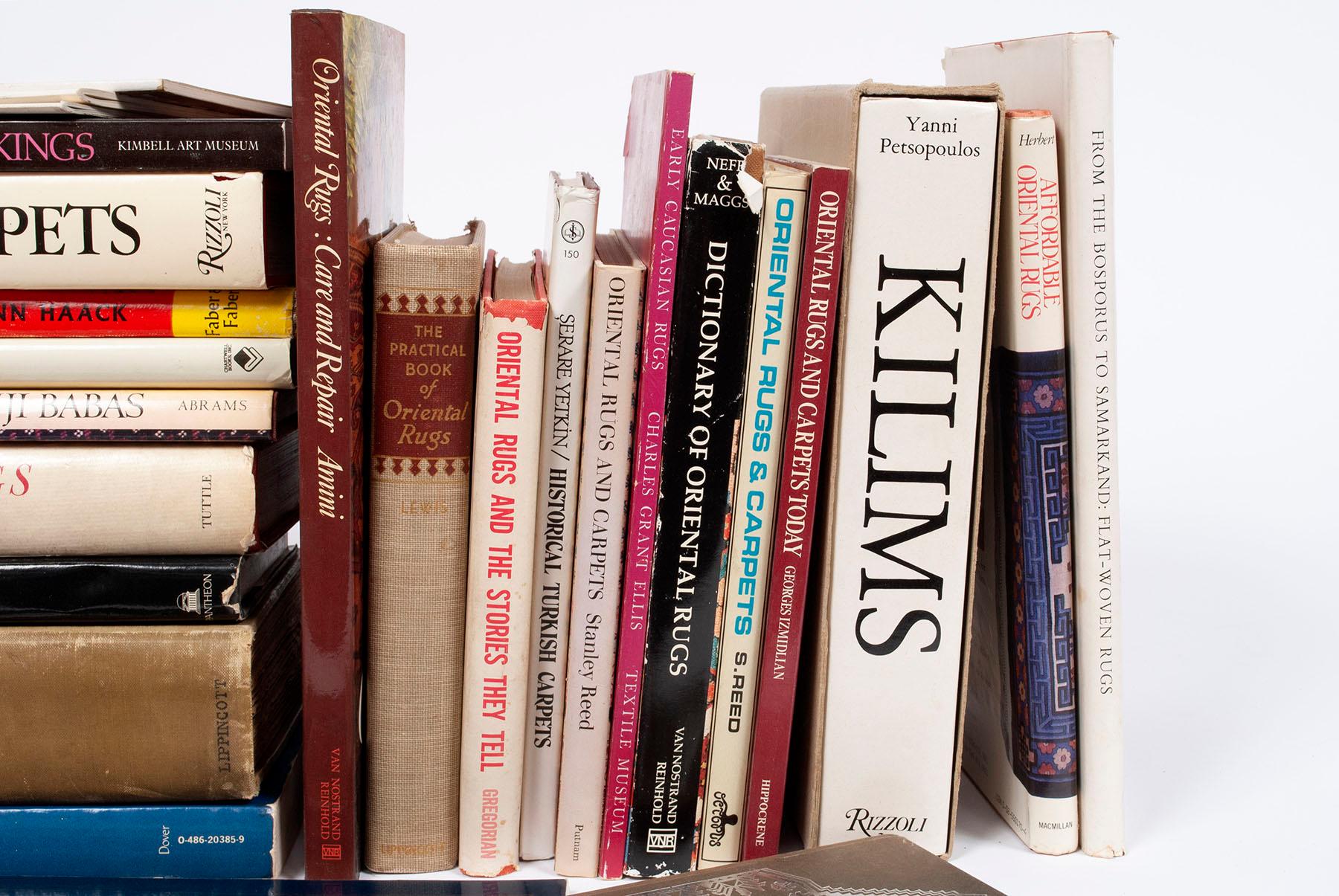
- G. Griffin Lewis. The Practical Book of Oriental Rugs. 1911, revised 1913.
- Erich Aschenbrenner. Oriental Rugs, Volume 2: Persian. 1981.
- Alexander Iyas. Views and People of Soujbulak in Winter. Photograph, 1914.
- Classical Numismatic Group. Coin of Fath-Ali Shah Qajar, minted in Savujbulagh. Photograph, CC BY-SA 2.5.





.jpg)
Laissez un commentaire