

An old Kerman carpet can look self-contained: a field of flowers, a carefully worked border, and years of skill held in wool. The object tells us much less about the business that commissioned it or the people who worked at the loom. In the late nineteenth and early twentieth centuries, the Kerman region became an important centre of carpet production for distant buyers. That shift changed what was ordered, how goods travelled and where labour was spent. It also left a record that is much less tidy than the rugs themselves.
Kerman was not a place that suddenly discovered weaving for export. It had an older textile economy in which shawls mattered greatly, and carpets had already been woven. During the Qajar period, capital and work were increasingly redirected toward carpets. The useful question is not whether foreign demand invented a craft, but how it altered the scale and organization of an existing one. That distinction matters if we want to understand an antique rug without treating every Kerman carpet as a product of the same workshop, customer or working conditions.
Before carpets took the lead
Kerman shawls were a significant product through much of the nineteenth century. They did not disappear the moment carpets became more attractive to merchants. The surviving accounts instead suggest an uneven transition: older skills and trades continued while carpet orders claimed more investment and labour. Historical observations of shawl workshops and workers were gathered by different observers using different definitions. They are evidence of a substantial industry, not a clean annual census from which we can calculate the exact year of its collapse.
The distinction between continuity and change is easy to lose in a short history of Persian rugs. If an article says simply that carpets “replaced” shawls, it makes a complicated local economy sound like a switch. Materials, skills, family income, merchant credit and the destination of finished goods all had to change. Some workers moved between products. Some households may have had more than one textile activity. The historical paper documents the larger redirection but cannot identify every individual workshop's path through it. A good picture of the period starts by leaving room for that unevenness.
Carpet production itself also had more than one geography. Kerman city was part of a network that included Ravar, Jupar and Rafsanjan. It would be misleading to imagine every rug sold under the regional name being designed, dyed, knotted and finished in one urban building. The paper describes agents and workshops in several places, and commercial orders travelled through that network. A label naming Kerman can identify a regional trade tradition without specifying the hands, town or commercial route behind a particular piece.
What an export order changed
Merchants did more than wait for completed rugs to appear. They connected demand, advances, materials and sales. Foreign and domestic firms helped determine which carpets would be made and where finished pieces might find buyers. Export orders could favour particular dimensions, designs and quantities. Workshops had to organize work to fulfil those orders while managing wages, raw materials and transport. This was a business system as well as a craft tradition.
No single foreign company ran all Kerman weaving. Historical company accounts cover several Iranian carpet centres, including places outside Kerman. Evidence from Sultanabad, for example, cannot simply be moved to Kerman because both places sold rugs abroad. The Kerman-specific material records merchant and agent activity, and a report from 1913–14 lists firms of different nationalities. That list belongs to one report and one moment. It is not a complete count of everyone who commissioned a carpet in the region.
The network mattered because a carpet is a slow product. A merchant's sale might happen far from the loom and long after the first yarn was prepared. Capital could be committed before weaving ended; a change in fashion abroad could be felt in local orders later. An individual rug's floral design cannot tell us what price the weaver received or whether an advance had been made. The attractive finished surface hides the agreements and risks that carried it into a showroom.
The paper also describes a market that was never entirely uniform. A consular account of Kerman carpets discusses luxury prices and the need to investigate buyers. That is evidence against the idea that all overseas customers wanted the same inexpensive standardized product. Designs and quality varied, as did who could afford the result. A late-Qajar Kerman carpet should be examined as an object in its own right, with its materials, structure and condition, before any broad export story is attached to it.
Nor did new demand guarantee uninterrupted prosperity. Commercialization accelerated from the 1890s, led in substantial part by local investors and merchants, before a sharp downturn in 1904. Contemporary accounts blamed overproduction, dye quality and designs that no longer appealed to buyers. Those explanations are themselves period judgments, not an experiment that identifies one cause of the downturn. But the episode does establish an important limit to the idea of a smooth export boom: a community whose income had shifted toward distant markets could also be exposed to changes in those markets. Direct European manufacturing ventures became more prominent after that lull. Local entrepreneurship and foreign influence therefore belonged to different stages of the story, not two mutually exclusive accounts of it.
A route is not a trend line
The business extended beyond the weaving centres. Commercial routes ran through Yazd and toward Bandar Abbas, with security and transport problems along the way. Those connections explain why a change in European or American demand could reshape work in an inland Iranian province. They also remind us that a rug's history continued after it left the loom: packing, inland movement, port handling and onward sale all sat between maker and customer.
Historical export figures appear to offer a neat measure of the transformation. One consular series cited in the paper puts carpets at 53.21 percent of its recorded exports for 1906–07. This is a striking number, but the denominator is the exports covered by that report, not everything Kerman produced. The later bars reproduced in the paper cannot be read as a continuous carpet-only share. Their routes and destinations change, and later categories sometimes bundle carpets with shawls or sheep. A 1913–14 figure of 97.78 percent, for example, combines carpets and shawls on a Bandar Abbas route to Europe and America. Joining those numbers into an upward line would make an unreliable chart look authoritative.
The two reported snapshots measure different slices of commerce. Their percentages belong beside their category and route definitions, rather than on a single rising line. The same care applies to a map: a documented route through Yazd to Bandar Abbas does not establish the journey of every Kerman rug.
The paper's wider argument is that outside demand and investment helped redirect Kerman's economy. The export figures support the importance of carpet commerce within the records they cover. They do not isolate a single cause. Local resources, existing textile skill, merchants, political conditions and transport all shaped what happened. The evidence is strongest when used to describe the change and its mechanisms, rather than to claim that carpet exports alone caused the decline of every other craft.

The people behind the finished surface
Carpets require time at the loom, and the conditions of that work are part of their history. Period accounts describe women and children in carpet production, low pay, long days and workshops with poor ventilation. Some reports describe home work; others concern workshops and the use of advances. These are troubling historical observations, but they are not a survey of every Kerman household or every carpet in the market. National figures quoted in the historical literature cannot be relabelled as Kerman-only counts.
The significance is larger than a number. When merchants and buyers gained from increased output, the benefits and burdens were not necessarily shared with those tying the knots. An ornate carpet might have passed through several commercial hands while the people who made it remained unnamed. This does not mean that we can infer the conditions of a specific antique rug from its pattern. It means the economic story cannot end at the merchant or the export port.
There is another risk in telling this history: reducing weavers to passive victims while celebrating the artistry of their work in a separate paragraph. Skilled weaving and unequal bargaining power can exist in the same industry. The complexity of a design testifies to practice and judgment; it does not prove fair pay. Conversely, evidence of exploitative conditions does not erase the makers' knowledge. The historical account becomes more truthful when these facts are held together rather than used as competing slogans.
The sources also have limits in whose voices they preserve. Commercial reports and travellers were more likely to record production, price and visible working conditions than a weaver's own account of a day or a negotiation. We should therefore be precise about what the record says. The accounts document reported conditions in the period, not the experience of every named or unnamed maker. A modern rug seller should not borrow this history to make an unverified claim about a particular old carpet's origin, age or ethical provenance.
What can an individual Kerman rug show?
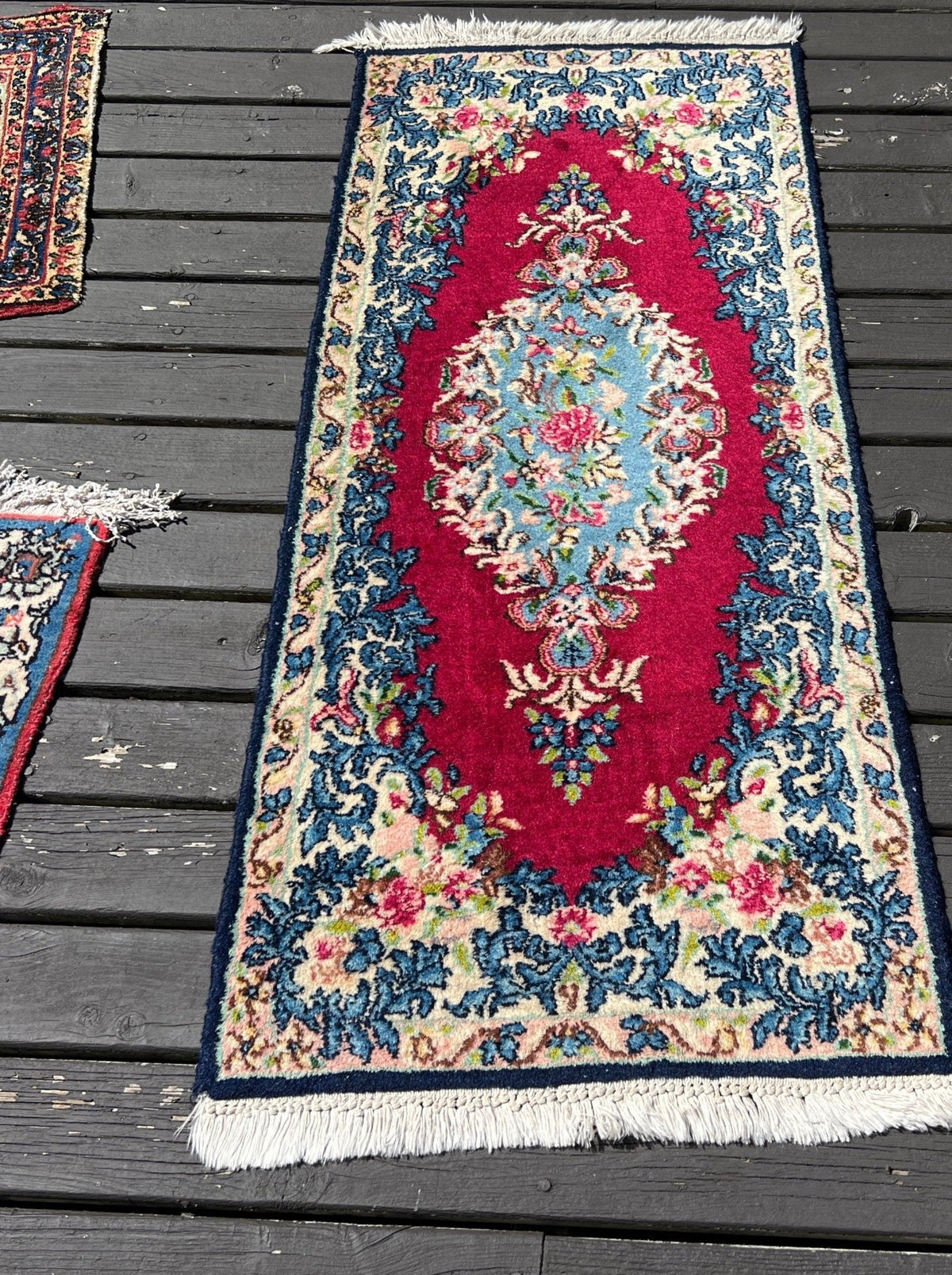
A rug catalogued by Rug the Rock as Kerman, circa 1920, offers a view of a floral medallion and border from just after the period discussed here. Its date is a seller attribution, not an independently documented workshop record. The photograph cannot show who ordered it, the route it travelled or the weaver's wage. Those connections require provenance records that may not survive. The rug makes the history visible as an object, while leaving the economic history to the written evidence.
For design, structure and dating questions beyond this economic history, see our guide to Kerman rugs. That distinction helps buyers as well as history readers. “Kerman” on a retail tag may describe an origin, style or trade attribution, and those are not identical claims. Ask what evidence supports the date and place, whether repairs or reweaving have been disclosed, and whether the stated condition matches photographs of the back, edges and high-wear areas. A carpet's design can invite further research; it should not be treated as documentary proof of a workshop or year.
Kerman's export growth is therefore best understood as a transformation of relationships. Older shawl production overlapped with rising carpet demand. Merchants and agents connected local work to distant customers. Trade routes carried finished pieces outward, while risk and unequal rewards remained close to the loom. The surviving numbers are valuable when their scope is kept visible. The rugs that remain deserve close looking, but their beauty is only one part of the history that made them possible.
Source
Reza Sehhat Manesh, “بررسی ارتباط نظام سرمایه داری با فرش بافی کرمان در دوره قاجار” [Capitalism and Carpet Weaving in Kerman during the Qajar Period] (2019).
James M. Gustafson, “Kerman xv. Carpet Industry” (2017), Encyclopaedia Iranica.





Leave a comment