

The Boteh is one of the most recognizable shapes in Persian textile design: a rounded body that narrows and bends at the tip, somewhere between a leaf, a flame, a seed, and a small cypress tree. In the West, a closely related version is usually called paisley.
That familiar outline can look simple, but its history is not. Scholars have connected the Boteh with plants, royal ornaments, feathers, wings, flames, and the cypress or tree of life. None of those interpretations explains every example. The most useful way to understand the motif is to begin with what can actually be seen, then consider the meanings that different researchers have proposed.
If you are looking for an available rug rather than a design-history lesson, browse our current Boteh and paisley-pattern rugs. Each product page should be used to evaluate the origin, materials, dimensions, age, and condition of that individual piece.
What is a Boteh?
Boteh, also transliterated as bota, buta, or boteh jegheh, is a Persian design term associated with a curved, leaf-like motif. Encyclopaedia Iranica defines bota literally as “bush” or “shrub” and describes it as a leaf with a curved tip. The same reference notes that Western audiences commonly recognize it as the pear- or teardrop-shaped motif of paisley shawls.
In a rug, the Boteh may appear as:
- a single large figure;
- repeated rows covering the field;
- alternating diagonal rows;
- a border ornament;
- part of a medallion-and-corner composition;
- a cluster of two, three, or more connected forms;
- a geometric figure combined with flowers, birds, branches, or stars.
The shape is flexible enough to move between finely curved workshop carpets and strongly geometric village or tribal weavings. That adaptability is one reason it appears across so many Iranian weaving regions.
Is Boteh the same as paisley?
They belong to the same broad design family, but the words carry different histories.
Boteh is the more useful term when discussing Persian carpets and textiles. Paisley became the familiar English name after patterned Kashmir shawls inspired large-scale shawl production in the Scottish town of Paisley. The V&A Dundee's account of the pattern's journey also emphasizes that the motif was known as buta or kolka in South Asia long before it became identified with Scotland.
Calling every Boteh “paisley” is understandable, especially in shopping language, but it can flatten a much richer history. A Persian rug dealer might use both terms so that the design is understandable to a broad audience: Boteh (paisley) motif.
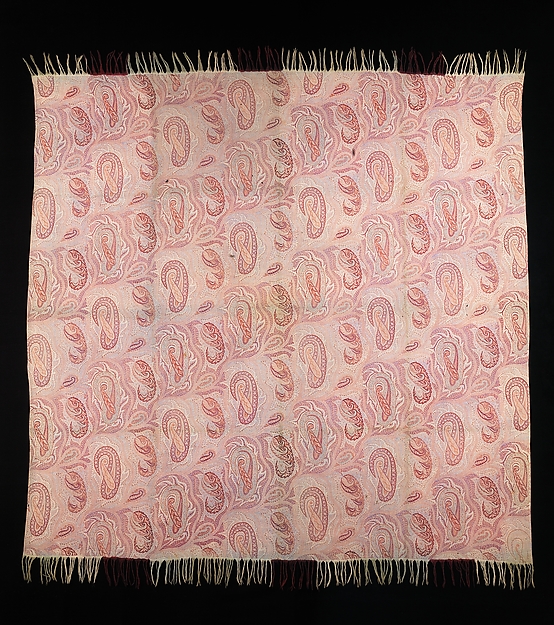
Figure: A British wool shawl, about 1850, showing a European adaptation of the Boteh. The Metropolitan Museum of Art, object 2009.300.2962.
Where did the Boteh motif come from?
There is no single origin story accepted by every scholar.
Some researchers connect the form to an ancient Iranian cypress, a tree associated in later interpretation with endurance, renewal, or everlasting life. Others have compared it with a feather or jeweled ornament worn on royal headgear, or with wing-like forms in pre-Islamic Iranian art. Another theory emphasizes the influence of Kashmir shawls and the movement of textile designs between India, Iran, and Europe.
The safest conclusion is modest: the exact birth of the motif remains debated, and its form developed through long periods of cultural exchange. Similarity alone does not prove that every Boteh represents a cypress, flame, feather, or religious symbol.

Two early Boteh-like ceramic forms: an Arak bowl and a Nishapur vessel associated with the fourth century AH.
The motif did circulate well beyond carpets. A nineteenth-century Qajar jacket in the British Museum, for example, uses repeating Botehs in an Isfahani silk brocade. Objects like this show how comfortably the shape moved between rugs, clothing, shawls, embroidery, and other decorative arts.
Figure: Wool shawl made in Kashmir in the nineteenth century. Its dense, highly stylized forms show one stage in the motif's development for European markets. The Metropolitan Museum of Art, object 2019.566.
Eight recognizable Boteh forms
These eight named examples show the range of Boteh forms used in rug design. The labels do not form a universal system, since regional names can overlap or change. They nevertheless demonstrate how far one basic outline can be transformed.

Eight named Boteh variants: simple, Miri, Termeh, Kashmiri, pear-shaped, horned, Bolvardi and Taki.
Simple Boteh
The simple form has a full rounded body and one curved tip. It is the clearest starting point for recognizing the motif, although even a “simple” Boteh may contain smaller flowers or outlines.
Miri Boteh
Miri Boteh is commonly associated with small, repeated forms arranged across the field. In the rug trade, the name often appears in connection with Saraband or Mir-pattern rugs. The label should not be used by itself as proof of where a rug was woven.
Termeh Boteh
This version is associated with the refined Boteh vocabulary seen in Persian termeh, a finely woven textile traditionally linked with shawls and luxury furnishing fabrics. It often has a more curved outline and detailed interior.
Kashmiri Boteh
Kashmiri forms are frequently elaborate, with decorative edges and complex internal flowers. They help explain why the shape became so strongly associated with Kashmir shawls and, later, Western paisley designs.
Pear-shaped and leaf-like Boteh
Some names describe appearance rather than origin. A fuller Boteh may be called pear-shaped, almond-like, or leaf-like. These comparisons are visual shorthand, not botanical identifications.
Horned and composite Botehs
In more geometric weavings, branches or horn-like extensions can grow from the main form. Multiple Botehs may also be joined at the base, placed inside one another, or organized like branches of a tree.

Figure: Boteh motifs can change through additions inside and outside the main outline, producing naturalistic, geometric, and composite variants.
Figure: Kashmir wool shawl, mid-nineteenth century, with appliquéd and embroidered panels. The variety of interior and exterior additions helps explain why Boteh classification is rarely simple. The Metropolitan Museum of Art, object 1987.437.2.
Bolvardi Boteh
Bolvardi and Qashqai weavings from Fars are especially important settings for abstract and geometric Boteh forms. Their angularity reflects both local design habits and the process of translating curves into a knot grid.
Taki Boteh
Taki is another named regional or compositional form illustrated here. Its complex interior demonstrates why Boteh classification is difficult: researchers have reported many dozens of variants, while only a smaller group of names is used consistently across publications.
Where does the Boteh appear in Persian rugs?
The motif is not limited to one city, tribe, or carpet type. Boteh appears extensively in Fars, particularly among Qashqai and Bolvardi weavings, with examples also found in Bijar, Hamadan, Kurdistan, Kerman, Kashan, Qom, Arak, and Turkmen weaving traditions.

Figure: Selected Qashqai Boteh compositions, including clustered, grouped, twin, and triple arrangements.
These regional connections are useful, but the motif alone cannot authenticate a rug. Designs travelled through trade, migration, workshop drawings, copied rugs, family traditions, and changing market taste. A Boteh field may support an attribution, but it should be considered together with structure, materials, colors, finishes, age, and documented provenance.
For regional context, compare our guides to Qashqai rugs and Persian Bidjar rugs.
What does the Boteh symbolize?
The honest answer is that its meaning depends on the object, period, maker, and interpreter.
Common interpretations include:
- a cypress or tree of life;
- a seed, leaf, shrub, or young plant;
- a flame;
- a feather or wing;
- fertility, renewal, continuity, or everlasting life.
These readings are part of the motif's cultural history, but they should not be presented as a fixed dictionary. A modern seller cannot know what an individual weaver intended unless there is direct evidence such as an interview, inscription, workshop record, or reliable provenance.
Good description begins with the visible form: “a repeating field of angular Botehs,” for example. A symbolic interpretation can then be introduced as a documented possibility rather than a fact about every rug.
How to recognize a Boteh-pattern rug
Start with the curved tip, but inspect the whole composition.
- Look for the basic silhouette. Most Botehs have a broad lower body and a tip bending to one side.
- Follow the direction. Motifs may all face the same way, alternate directions, or run diagonally across the field.
- Inspect the interior. Flowers, leaves, diamonds, birds, small Botehs, and geometric compartments may sit inside the outline.
- Notice the drawing style. Workshop carpets can render the shape with flowing curves; village and tribal rugs may make it stepped or angular.
- Separate pattern from origin. A Boteh does not by itself prove that a rug is Persian, Qashqai, Bijar, Kashmir, or antique.
- Check the reverse. Foundation fibres, knot structure, wefting, sides, ends, repairs, and wear provide evidence that the surface design cannot.
Our antique rug glossary explains related design and construction terms, while the guide to Persian rug types places regional labels in a broader context.
Choosing a Boteh or paisley rug
Choose the individual rug, not a story attached to the motif.
Consider whether the scale of the repeat suits the room, whether the pattern feels calm or energetic, and how the colors interact with existing furniture. Then assess condition, repairs, pile, foundation, dimensions, and origin. Older rugs may show wear or restoration; those features should be described clearly rather than hidden behind claims of rarity or investment value.
Explore the current Paisley Rugs collection to compare available Boteh compositions. Because every handmade rug is different, rely on the measurements, condition notes, materials, and photographs supplied for the specific piece.
Frequently asked questions
What does Boteh mean?
The Persian word is commonly translated as “bush” or “shrub.” In carpet studies it names a curved leaf-like motif with many regional and compositional variations.
Is a Boteh always a tree of life?
No. The cypress or tree-of-life interpretation is influential, but it is one theory among several and should not be applied automatically to every example.
Are paisley rugs Persian?
Some are, but the motif also appears in Indian, European, Central Asian, and other textile traditions. Origin must be established from the complete object, not the pattern alone.
What is a Mir-i Boteh rug?
The term usually refers to rugs with small repeating Miri Botehs, often associated in the market with Saraband-area weaving. Labels vary, so construction and provenance still need to be evaluated.
Does a Boteh motif make a rug antique or valuable?
No. The motif has been used across many periods and quality levels. Value depends on the specific rug's origin, age, condition, materials, workmanship, design, size, provenance, rarity, and current market demand.
Sources
- Primary authoritative source: Fatemeh Dorjvar, “A Study of the Boteh Motif in Iranian Carpets” [Persian], Goljaam: Scientific-Research Journal of the Iranian Carpet Scientific Association, no. 28, 2015, pp. 59–72. DOR: 20.1001.1.20082738.1394.11.28.4.2.
- Supplementary context only: Encyclopaedia Iranica; V&A Dundee; British Museum.





Leave a comment